

This website uses cookies to enable its essential functions, personalize content and advertisements, provide social media features, and analyze website traffic. We may also share information about your use of our site with our social media, advertising, and analytics partners.
"Major Issues" (determined based on questionnaire results) will be identified and analyzed in four steps:
- Identify stakeholders
- Define major issues
- Conduct on-site investigations
- Compile results and create a major issue matrix
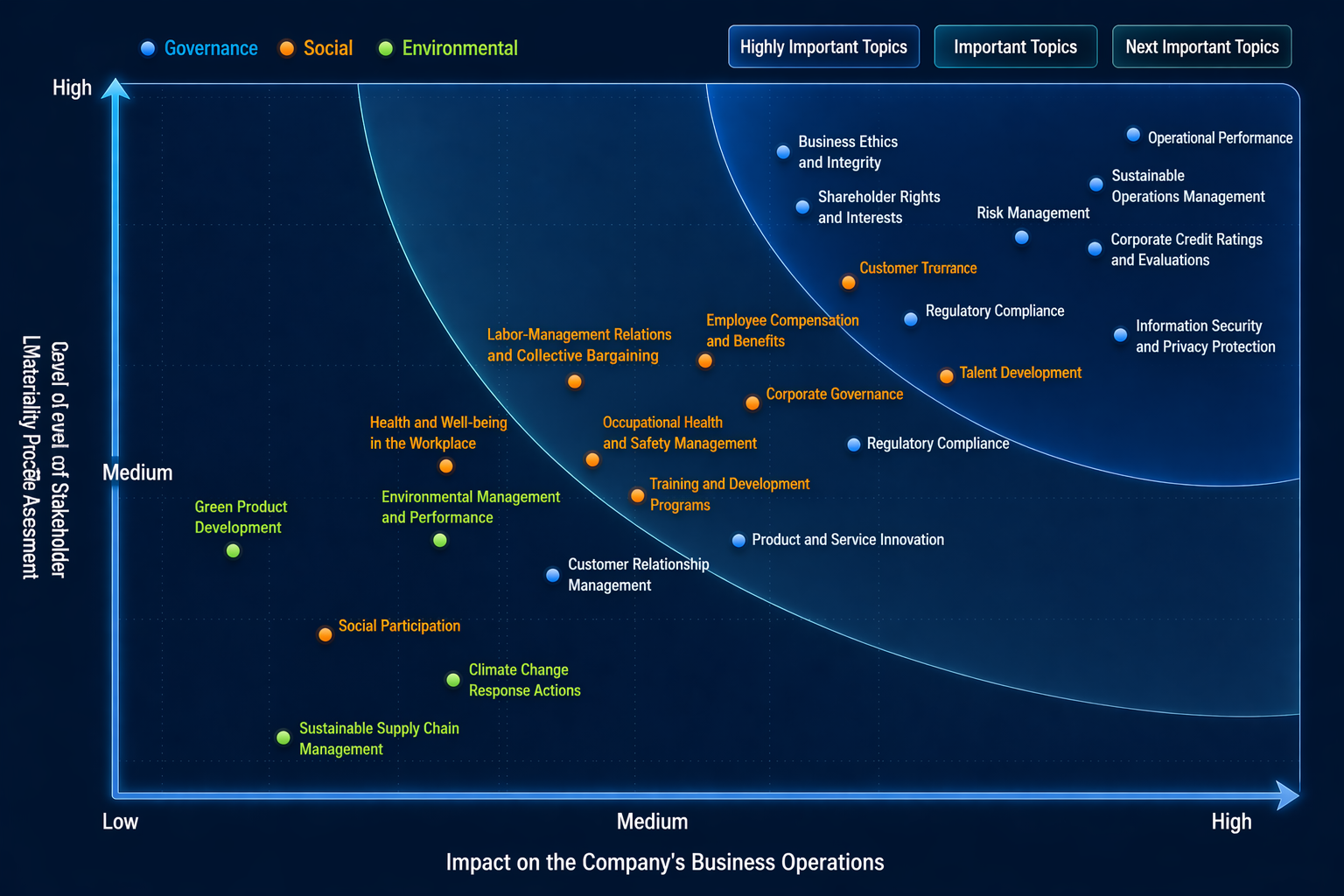
Major Themes and Policies – A Dual Assessment of Significance:
The core steps of dual materiality analysis include:
Internal identification: As mentioned above, Moody has completed the identification and analysis of the positive and negative impacts of its operations and business relationships on the external environment, society, and human rights (i.e., "impact materiality," referring to the "Major Theme Identification" guidance in GRI Guideline 3-2).
External assessment: Next, Moody assesses the impact of sustainability issues with impact materiality on financial condition, performance, and cash flow (i.e., "financial materiality").
Integrated analysis: The results from the above two aspects are integrated to form a comprehensive materiality matrix to reveal the company's sustainability information.
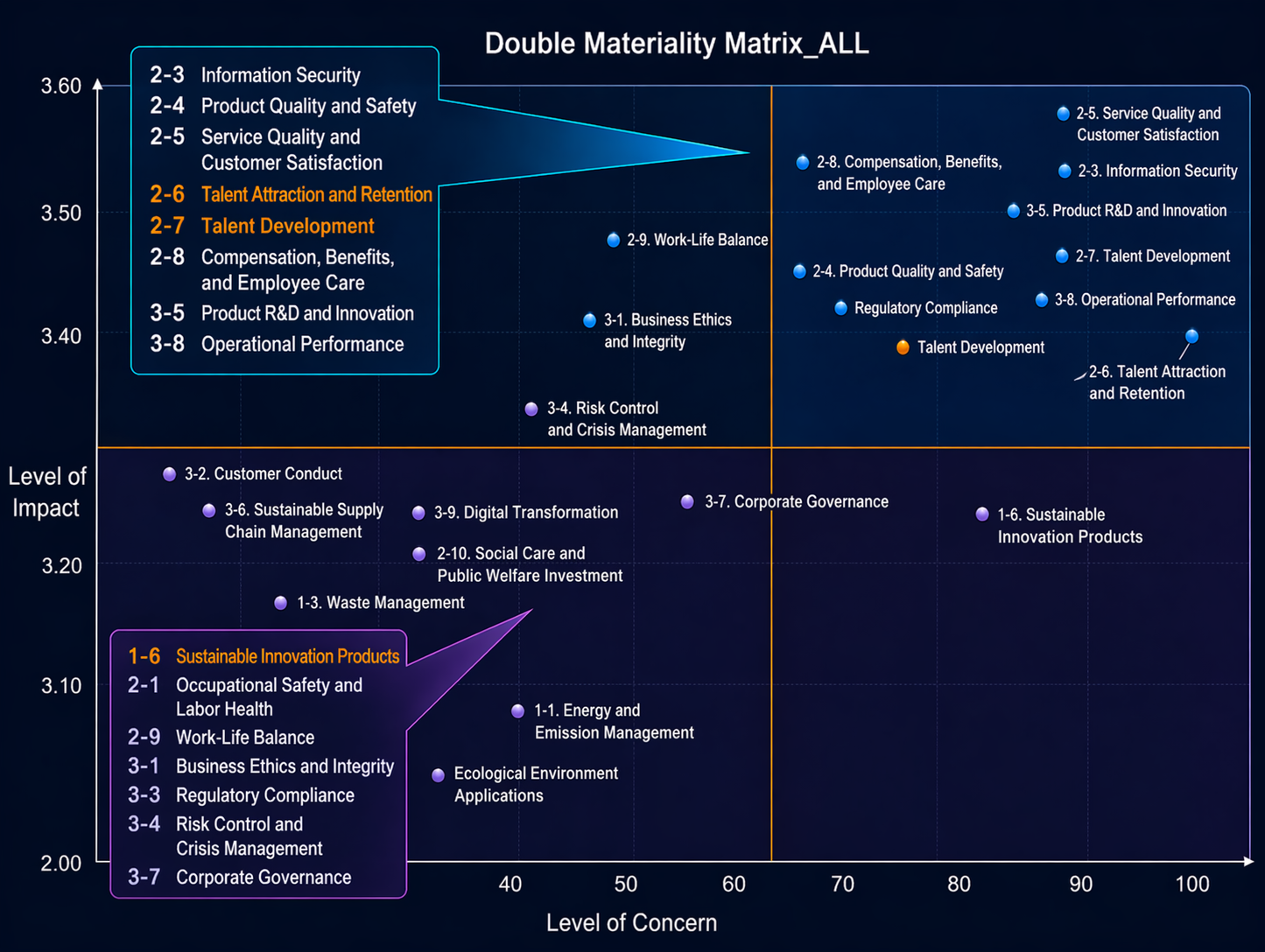
Major Themes and Policies – Prioritization and Changes of Themes of Dual Importance:
The ordering and changes of topics of dual importance are shown in the table below.
| Impact Material Topic Ranking | Reasons for Changes in Impact Material Topics | Financial Impact of Impact Material Topics | Reordering of Double Materiality Topics | ||||
| No. | 2024 | 2023 | Negative | Positive | Total Weight | Topic Rank Adjustment | |
| 1 | 2-1 Occupational Safety and Labor Health | 2.3 Information Security | Change in double materiality ranking, from 7→1 | Low | High | 11 | 5 |
| 2 | 2-3 Information Security | 2-4 Product Quality and Safety | Change in double materiality ranking, from 1→2 | High | Low | 11 | 6 |
| 3 | 2-4 Product Quality and Safety | 2-5 Service Quality and Customer Satisfaction | Change in double materiality ranking, from 2→3 | High | High | 20 | 1 |
| 4 | 2-5 Service Quality and Customer Satisfaction | 2.7 Compensation, Benefits, and Employee Care | Change in double materiality ranking, from 3→4 | Medium | High | 15 | 4 |
| 5 | 2.8 Compensation, Benefits, and Employee Care | 3-5 Product R&D and Innovation | Change in double materiality ranking, from 4→5 | Low | High | 11 | 7 |
| 6 | 3-5 Product R&D and Innovation | 3-8 Operational Performance | Change in double materiality ranking, from 5→6 | High | High | 20 | 2 |
| 7 | 2-6 Talent Attraction and Retention | 2-1 Occupational Safety and Labor Health | Change in material topic name: the original “2-6 Talent Recruitment, Training and Succession” was split into “2-6 Talent Attraction and Retention” and “2-7 Talent Development” | Low | High | 11 | 8 |
| 8 | 2-7 Talent Development | 2-6 Talent Recruitment, Training and Succession | Change in material topic name: the original “2-6 Talent Recruitment, Training and Succession” was split into “2-6 Talent Attraction and Retention” and “2-8 Talent Development” | High | High | 20 | 3 |
| 9 | 2-9 Work-Life Balance | 2-8 Work-Life Balance | No change | Low | High | 11 | 9 |
| 10 | 3-1 Business Ethics and Integrity | 3-1 Business Ethics and Integrity | No change | High | Low | 11 | 10 |
| 11 | 3-3 Regulatory Compliance | 3-4 Risk Control and Crisis Management | New entry | Low | Low | 2 | 11 |
| 12 | 3-4 Risk Control and Crisis Management | 3-6 Sustainable Supply Chain | Change in double materiality ranking, from 11→12 | Low | Low | 2 | 12 |
| 13 | 3-6 Sustainable Supply Chain | 3-7 Corporate Governance | Change in double materiality ranking, from 12→13 | Low | Low | 2 | 13 |
| 14 | 3-7 Corporate Governance | 3-7 Corporate Governance | Change in double materiality ranking, from 13→14 | Low | Low | 2 | 14 |
| 15 | 3-8 Operational Performance | 3-8 Operational Performance | Change in double materiality ranking, from 6→15 | Low | Low | 2 | 15 |
- Definition of Financial Impact (Positive/Negative): Negative: Costs incurred by doing it or financial losses from not doing it; Positive: Financial feedback after doing it.
- Definition of Financial Impact Weighting Score: High: 10 points, Medium: 5 points, Low: 1 point